
Yes, you can be charged with DUI after police find you in a parked car in South Carolina, but a charge is not the same as a conviction. South Carolina DUI law focuses on whether you drove a motor vehicle while your faculties to drive were materially and appreciably impaired. In a parked car case, the case often turns on proof of driving, proof of impairment, officer observations, video, witness statements, and whether the State can connect your condition to actual vehicle movement.
If you were asleep, waiting for a ride, sitting with the engine on, or parked outside a bar, park, apartment complex, campus area, or private home, the details matter. The State still has to prove the required elements of DUI.
Can You Get a DUI While Parked in South Carolina? 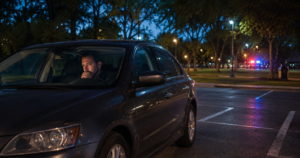
A parked car DUI case usually starts with confusion. You may have believed you were making a safer choice by not driving. Then an officer approached the vehicle, asked questions, noticed signs of alcohol use, and made an arrest.
South Carolina Code Section 56-5-2930 makes it unlawful to drive a motor vehicle while under the influence of alcohol, drugs, or a combination of substances to the extent that your faculties to drive are materially and appreciably impaired. The word drive matters. Unlike some states that base DUI liability on “actual physical control,” South Carolina DUI cases generally require proof that the person drove the vehicle while impaired.
That distinction can make a major difference when the car was parked before law enforcement arrived. In State v. Graves, the South Carolina Supreme Court addressed the meaning of “drive” in a DUI case and treated driving as requiring movement of the vehicle. That issue can be central when police find a person in a stopped or parked vehicle.
350+ Reviews

5.0 Star Average





Why Police May Still Make a Parked Car DUI Arrest
Even when an officer does not see the vehicle moving, police may still believe there is enough evidence to charge DUI. Common facts that lead to a parked car DUI arrest include:
You were sitting in the driver’s seat.
The keys were in the ignition, your hand, your pocket, or the center console.
The engine was running or the vehicle lights were on.
The vehicle was parked partly in a lane of travel, at a gas station pump, in a lot, or near the roadway.
A witness reported seeing the vehicle move.
You made a statement about driving before the officer arrived.
The officer observed alcohol odor, slurred speech, balance problems, or poor field sobriety test performance.
These facts do not automatically prove DUI. They may give the officer a reason to investigate. The defense question is whether the State can prove every required element beyond a reasonable doubt.
Callout:
Being near a vehicle is not the same thing as driving it.
In a parked car DUI case, proof of movement can matter.
The Difference Between Being in a Car and Driving a Car
One of the most important issues in a South Carolina parked car DUI case is whether the State can prove driving. Sitting in a parked vehicle can raise suspicion, but suspicion is not enough by itself.
A prosecutor may try to prove driving through direct evidence, such as an officer seeing the car move. More often, parked car cases involve circumstantial evidence. That means the State may rely on surrounding facts to argue that you recently drove while impaired.
Examples may include a driver found asleep in a running vehicle in a fast food drive-through, a car stopped in a travel lane, a vehicle parked after a reported collision, or a person who admits they drove from one location to another.
The defense may focus on a different explanation. Maybe the car had not moved for hours, someone else drove, you drank only after parking, or the officer assumed too much from the location of the keys.




What If the Engine Was Running in a South Carolina Parked Car DUI Case?
An engine that is running can make the case harder, but it does not end the analysis. People start parked cars for reasons that do not involve driving. They may need air conditioning during a humid Greenville evening, heat during a cold Upstate South Carolina night, or battery power to charge a phone while waiting for help.
The State may argue that a running engine shows an ability and intent to drive. The defense may respond that DUI requires proof of driving, not merely access to a functioning vehicle. The surrounding facts matter, including where the car was parked, whether the officer saw movement, who had access to the car, and what the video shows.
What If You Were Asleep in the Driver’s Seat?
Sleeping in the driver’s seat often leads to a DUI investigation, especially if the keys are nearby. Officers may knock on the window, ask you to step out, request field sobriety tests, and begin questioning where you came from.
Being asleep can cut both ways. The officer may view it as evidence of impairment. At the same time, sleeping can support the argument that you stopped driving or never intended to drive. If the car was safely parked and there is no reliable proof of recent movement, the defense may have a meaningful issue to raise.
You should not assume that sleeping in a parked car protects you from arrest. You should also not assume that an arrest means the State can prove DUI.
"John Bateman is my absolute go to peer in the legal field when it comes to questions about DUI. . . . He has an innate ability to convey to clients what really matters in their cases. As a fellow attorney, I highly recommend John to anyone in the SC or NC areas who are looking for... legal representation when facing a DUI charge." "John is an excellent DUI attorney. He has received the same field sobriety test training as all police officers in the State, and also the same training as the people who are the instructors of the police officer training courses on field sobriety tests. He is very passionate about DUI's and I recommend him often to people who are facing serious charges in the upstate area." "Very knowledgeable and thorough in his preparation and representation of his clients. He cares for each of his clients and works extremely hard to achieve results. I highly recommend this lawyer.""He has an innate ability to convey to clients what really matters in their cases."
M. Brock

"An excellent DUI attorney. He has received the same field sobriety test training as all police officers in the State"
P. Hammond
"He cares for each of his clients and works extremely hard to achieve results."
C. Grubbs
Can You Be Charged on Private Property?
South Carolina DUI law can apply beyond public highways. The traffic chapter includes provisions applying certain DUI-related rules on highways and elsewhere throughout the state. That means a DUI investigation can arise in a private parking lot, apartment complex, campus area, driveway, restaurant lot, or park area.
Parking lot cameras, body camera footage, dispatch notes, and witness statements may matter. These sources may show where the vehicle was, whether it moved, who was driving, and what happened before police arrived.
Field Sobriety Tests and Breath Tests in Parked Car Cases
Parked car DUI cases often involve field sobriety tests and breath testing, even if the officer did not see driving. South Carolina’s implied consent law addresses chemical testing after a DUI arrest arising from acts alleged to have occurred while the person was driving under the influence. The law also sets rules for how test results may be used and what inferences may apply at different alcohol concentration levels.
Testing can become complicated when the driving issue is unclear. A breath result may show alcohol in your system at the test time, but the State still has to connect impairment to driving. Timing matters. If there was a long delay between alleged driving and testing, the defense may question whether the number reflects your condition when the vehicle allegedly moved.
The Bateman Law Firm explains more about testing challenges at https://duigreenville.com/challenging-breathalyzer-results-in-south-carolina-dui-cases/.
Refusing Field Sobriety Tests Choosing a DUI AttorneyRelated Videos
Possible Defenses to a Parked Car DUI Charge
There is no single defense that fits every parked car DUI case. The strongest approach depends on the facts, video, reports, witness accounts, and testing records.
Possible defense issues may include:
Lack of proof that you drove the vehicle.
No officer observation of actual movement.
Another person may have driven.
You consumed alcohol only after parking.
The vehicle was legally parked and not in traffic.
The keys were not in the ignition.
The officer misread fatigue, illness, anxiety, or a medical condition as impairment.
Field sobriety tests were not properly explained or fairly administered.
Breath or blood testing procedures were flawed.
Video evidence does not match the written report.
The stop, detention, arrest, or questioning violated your rights.
The Bateman Law Firm discusses related DUI defense issues at https://duigreenville.com/defenses-to-a-dui-charge/.
What You Should Do After a Parked Car DUI Arrest
After a DUI arrest, avoid trying to explain everything to police, court staff, or prosecutors on your own. What you say can be used against you, even if you were trying to be helpful.
Write down what happened as soon as you can, including:
Where the car was parked.
Who drove.
When you consumed alcohol or medication.
Whether the engine was running.
Where the keys were.
Whether cameras were nearby.
What the officer said and did.
Whether anyone else saw what happened.
If your license is at risk because of a DUI arrest or testing issue, act quickly. The firm has more information about license concerns at https://duigreenville.com/what-happens-to-your-drivers-license-after-a-south-carolina-dui-arrest/ and what to do after an arrest at https://duigreenville.com/what-to-do-if-youre-arrested-for-dui-in-south-carolina/.
Why Local DUI Defense Experience Matters
A parked car DUI charge may be heard in a municipal, magistrate, or county court, depending on where the arrest occurred and how the charge is filed. Cases in Greenville, Clemson, Spartanburg, Pickens, Anderson, and nearby Upstate South Carolina communities can involve different police agencies, court procedures, and local evidence sources.
The Bateman Law Firm focuses on South Carolina DUI defense and offers free consultations for people facing DUI accusations. The firm understands that many people in parked car cases were trying to avoid driving, trying to rest, or trying to make a safer choice. A defense lawyer can examine whether the State can prove driving, whether impairment evidence is reliable, and whether police followed the rules.
You can learn more about the firm’s DUI defense work at https://duigreenville.com/lawyer-for-duidwi-charges/.
Talk With a South Carolina DUI Defense Lawyer
If you were charged with DUI in a parked car, do not treat the case as hopeless. The facts may give your lawyer room to challenge the driving element, the impairment evidence, the officer’s assumptions, or the testing process.
Contact The Bateman Law Firm for a free consultation if your case arose in Greenville, Clemson, Spartanburg, or elsewhere in Upstate South Carolina. Call (864) 406-3004 to discuss your case with a South Carolina DUI defense lawyer.
This article is for informational purposes only and is not legal advice. Consult an attorney about your specific situation.