
DUI roadside conditions in South Carolina can affect how police observations and field sobriety test results are interpreted. Uneven pavement, poor lighting, passing traffic, road markings, and the position of police vehicles may help explain a driver’s movements or performance during roadside sobriety tests. South Carolina DUI cases also involve questions about why the vehicle was stopped, what officers observed, and what video recordings show. The Bateman Law Firm helps drivers in Greenville, Clemson, Spartanburg, and nearby Upstate South Carolina communities examine roadside details together with police recordings, officer reports, and other available evidence.
Why Does the Exact Location of a DUI Stop Matter?
Key takeaway: A roadside setting may explain particular driving movements or test behaviors, but it must be evaluated alongside the full record.
When reviewing a DUI arrest, the focus often falls on the officer’s observations, field sobriety tests, and chemical test results. Yet the physical environment can influence what officers observe and what a driver can reasonably accomplish during an investigation.
A person standing on a narrow shoulder beside moving traffic faces different conditions from someone performing the same exercises in an empty, level parking lot.
The location also provides context for the driving behavior that initially attracted police attention.
For example, an officer might report that a vehicle drifted toward a lane marking. Reviewing the scene could reveal a roadway curve, temporary construction markings, or an obstacle that required the driver to adjust position.
Those details do not automatically establish that the driver acted lawfully. They may offer an explanation that deserves consideration alongside the officer’s account.
South Carolina Code Section 56-5-2930 generally prohibits driving while under the influence of alcohol, drugs, or a combination of substances to the extent that the person’s faculties to drive are materially and appreciably impaired.
A DUI investigation must be assessed against the applicable legal requirements and the evidence. The location can contribute to that assessment.
Uneven Pavement, Slopes, and Roadside Shoulders
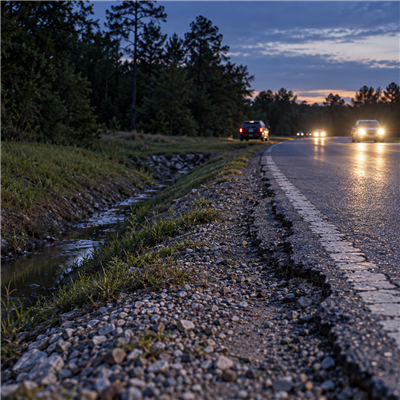
One of the first details worth examining is the condition of the surface where officers conducted field sobriety tests.
Certain roadside exercises require a driver to walk in a straight line, maintain balance, or stand on one leg. The surface beneath the person’s feet can affect those tasks.
Relevant conditions may include:
- Sloped pavement or a shoulder that drops away from the roadway.
- Loose gravel, potholes, cracks, or uneven concrete.
- Raised pavement edges or drainage areas.
- Wet surfaces, loose debris, or unstable ground.
- Limited space that prevents a normal walking pattern.
Consider a hypothetical DUI stop along a road outside Greenville.
An officer directs the driver to complete a walk-and-turn exercise on a paved shoulder. The shoulder slopes toward a drainage ditch, and the driver steps sideways while attempting to maintain balance.
That movement might be interpreted as a sign of impairment. The slope could also provide an innocent explanation for part of the behavior.
The distinction matters because roadside testing is supposed to help assess possible impairment, not simply identify whether someone can perform a balancing exercise under difficult conditions.
An attorney may examine whether the testing location was appropriate, whether the officer accounted for its condition, and whether a different location was reasonably available.
Related Videos
Refusing Field Sobriety Tests
Choosing a DUI Attorney
Lighting and Visibility During a DUI Investigation
A roadside location may look substantially different depending on the time of day and available lighting.
During nighttime investigations, officers may rely on streetlights, headlights, patrol vehicle lighting, or flashlights.
Lighting conditions can influence several parts of the encounter.
A driver might have difficulty seeing pavement markings, following a visual demonstration, or identifying obstacles near the testing area. Bright lights may also create glare or make it uncomfortable to look in a particular direction.
For an officer, limited visibility may affect the ability to observe certain movements accurately.
These concerns deserve particular attention when examining the horizontal gaze nystagmus test, commonly called the HGN test.
During this examination, an officer observes eye movements while directing the person to follow a stimulus. The conditions surrounding the examination and the officer’s administration of the test can matter when assessing its evidentiary value.
South Carolina appellate decisions have considered whether recorded footage adequately documents an HGN examination. The effect of any recording deficiency requires a case-specific review under applicable law.
The practical question is not simply whether the scene was dark. It is whether the available evidence reliably shows what occurred and supports the conclusions being drawn.
An examination of the recording may also establish whether the patrol vehicle’s position or nearby lighting affected visibility.


350+ Reviews
5.0 Star Average






Passing Traffic, Noise, and Roadside Distractions
A DUI stop beside a busy road can create conditions that are difficult to reproduce in a controlled environment.
Passing vehicles produce noise, headlights, and movement. A narrow shoulder may leave limited room between a driver, an officer, and traffic.
These surroundings may affect concentration, balance, and communication.
Suppose an officer instructs a driver to take a specific number of heel-to-toe steps. At the same moment, a large vehicle passes close to the testing area.
The driver briefly looks toward traffic and pauses.
An officer may interpret that pause as a failure to follow instructions. The driver may have been reacting to a nearby vehicle.
Neither explanation should be accepted automatically. The relevant question is what the evidence actually supports.
Audio from police recordings may help determine whether instructions were audible. Video may show passing vehicles or interruptions during the examination.
This is one reason discovery in a DUI case extends beyond chemical test records. For more information, visit https://duigreenville.com/importance-discovery-in-a-dui-case/. Police recordings, reports, and other available materials can help reconstruct the circumstances of an investigation.
Road Design and the Reason for the Initial Traffic Stop
The roadside location matters even before field sobriety testing begins.
Police generally need a legally sufficient basis to initiate a traffic stop. That basis is evaluated separately from whether officers later develop probable cause for a DUI arrest.
Roadway design may help explain observations such as unusual lane positioning, sudden braking, or an apparent failure to maintain a straight path.
For example, consider a vehicle traveling through an area with temporary traffic-control devices.
An officer observes the vehicle move toward the center of the roadway.
If construction barriers narrowed the usable lane, the driver’s movement might have an explanation unrelated to alcohol or drug impairment.
Other location details could include unclear lane markings, damaged pavement, an unusual intersection layout, or a vehicle avoiding an obstruction.
An attorney reviewing the circumstances of a DUI traffic stop may compare the officer’s stated reason with the physical layout and available recordings.
A questionable stop can raise constitutional issues, but an unusual road feature does not, by itself, make a stop unlawful.
The analysis depends on what the officer knew or observed when the stop occurred and the legal grounds for the detention.
Where the Driver Stopped Versus Where Testing Occurred
Another detail is whether the vehicle was stopped in the same location where the roadside investigation took place.
An officer may initially stop a vehicle in one area and direct the driver to move to a nearby location before conducting testing.
That difference can matter when reviewing the sequence of events.
For instance, the initial stop may occur along a road with limited shoulder space, while testing takes place on a flatter surface near a parking area.
In that situation, roadway conditions at the original stop may help explain driving observations, but they may not explain difficulties with a balance exercise performed somewhere else.
A careful review should distinguish between the location of the alleged traffic violation, the place where the vehicle stopped, and the location where tests were administered.
This can also help clarify the timing of officer observations and whether the evidence documents the full sequence.
Related Videos
Drug Arrest Mistakes
Cost of an Attorney
What Can Police Video Reveal About the Roadside Location?
South Carolina Code Section 56-5-2953 establishes video-recording requirements for specified DUI-related investigations, subject to statutory exceptions and judicial interpretations.
The statute addresses recording at the incident site and breath-test site, including the documentation of field sobriety tests.
The recording can help an attorney examine the circumstances of a roadside investigation rather than relying exclusively on written descriptions.
A review may focus on whether the footage shows the testing surface, surrounding traffic, lighting, driver movements, and instructions.
The angle of the camera matters.
A recording centered on the driver may not show a pothole near the driver’s feet. A patrol vehicle positioned at an angle may capture movements without adequately displaying the slope of the road.
Similarly, audio may record instructions but fail to capture background sounds clearly.
The recording should be evaluated for both what it shows and what falls outside the camera’s view.
South Carolina courts have interpreted the recording statute, including in State v. Gordon and State v. Taylor. The consequences of a recording deficiency depend on the statutory text, the facts, recognized exceptions, and controlling judicial decisions. A deficiency does not automatically resolve every DUI charge.
You can read more in the firm’s guide to South Carolina DUI videotaping laws: https://duigreenville.com/dui-videotaping-laws-south-carolina/.
Can Roadside Conditions Affect Field Sobriety Test Reliability?
Roadside conditions can affect the interpretation of field sobriety tests, but their significance varies with the test administered and the surrounding circumstances.
A sloping surface is particularly relevant to a test involving balance or walking. Poor lighting may raise different concerns about visibility and instructions.
Other considerations include footwear, physical limitations, fatigue, and whether the person understood what was being requested.
These factors should not be treated as interchangeable explanations for every observed sign of impairment.
For example, uneven pavement may explain an unsteady step, but it does not necessarily explain unrelated evidence such as an admission about drinking.
An attorney may assess each observation individually and then consider the combined evidence.
That approach is part of evaluating potential defenses to a South Carolina DUI charge. See https://duigreenville.com/defenses-to-a-dui-charge/ for related discussion.
It also helps distinguish between challenging the reliability of a particular roadside observation and challenging the prosecution’s broader case.
What Should You Record About the Location After a DUI Arrest?
If you have been arrested for DUI, details about the roadside location may become harder to reconstruct as time passes.
Construction zones change. Temporary signs disappear. Pavement repairs alter the surface. Lighting conditions may differ when someone returns to the scene.
You can begin by writing down what you remember without guessing or trying to make the events fit a particular explanation.
Useful details include:
- The road, intersection, or recognizable location where police first activated their lights.
- Where you ultimately stopped and where any sobriety tests occurred.
- Whether the ground was level, sloped, gravel-covered, or damaged.
- What you could see and hear during the investigation.
- Whether traffic, headlights, or other distractions affected your ability to concentrate.
- Whether officers moved you between locations or changed the testing area.
Photographs of a publicly accessible location may be useful when they can be obtained safely and lawfully. Do not enter traffic lanes, trespass, or interfere with an investigation to collect evidence.
When documenting the scene, preserve the date and explain whether conditions have changed since the arrest.
An attorney can consider what additional evidence may be available through the legal discovery process or appropriate preservation requests.




Why Roadside Details Should Be Reviewed Alongside Other Evidence
The location of a DUI arrest is one part of a larger investigation.
An uneven shoulder does not automatically invalidate field sobriety tests. Poor lighting does not prove that an officer’s observations were incorrect. A roadway obstruction does not necessarily justify every driving maneuver.
Yet dismissing these details without examination can leave relevant questions unanswered.
The stronger approach is to compare the reported observations with the physical surroundings, available recordings, testing procedures, and other evidence.
If the driver appeared unsteady, what was the surface like? If a test instruction was misunderstood, what does the audio reveal? If lane movement prompted the stop, what does the roadway layout show?
Each answer helps establish a more complete picture of the encounter.
"He has an innate ability to convey to clients what really matters in their cases."
"John Bateman is my absolute go to peer in the legal field when it comes to questions about DUI. . . . He has an innate ability to convey to clients what really matters in their cases. As a fellow attorney, I highly recommend John to anyone in the SC or NC areas who are looking for... legal representation when facing a DUI charge."
M. Brock

"An excellent DUI attorney. He has received the same field sobriety test training as all police officers in the State"
"John is an excellent DUI attorney. He has received the same field sobriety test training as all police officers in the State, and also the same training as the people who are the instructors of the police officer training courses on field sobriety tests. He is very passionate about DUI's and I recommend him often to people who are facing serious charges in the upstate area."
P. Hammond
"He cares for each of his clients and works extremely hard to achieve results."
"Very knowledgeable and thorough in his preparation and representation of his clients. He cares for each of his clients and works extremely hard to achieve results. I highly recommend this lawyer."
C. Grubbs
Reviewing a DUI Arrest in Greenville, Clemson, or Spartanburg
If you are facing a DUI charge in Upstate South Carolina, the location of the stop may provide context that is missing from a brief arrest report.
The Bateman Law Firm can review the available evidence and assess whether roadside conditions raise relevant questions about the traffic stop, field sobriety testing, or officer observations.
To discuss the circumstances of your arrest, contact The Bateman Law Firm to request a consultation. The firm serves Greenville, Clemson, Spartanburg, and nearby Upstate South Carolina communities. The legal issues and options available depend on the facts of your individual case.
This article is for informational purposes only and is not legal advice. Consult an attorney about your specific situation.