
Yes. You can be arrested for DUI after a Clemson football tailgate if you drive and law enforcement believes alcohol, drugs, or a combination of substances materially and appreciably impaired your ability to operate a motor vehicle.
Coming from a Clemson game, tailgate, restaurant, or watch party does not create a different DUI standard. South Carolina DUI law still applies. Game-day traffic, crowded parking areas, fatigue, roadside conditions, field sobriety testing, chemical testing, and video evidence may all affect how the evidence is evaluated.
The Bateman Law Firm represents people facing DUI charges in Clemson, Greenville, Spartanburg, and nearby areas throughout Upstate South Carolina. The firm also has a Clemson office at 145 Thomas Green Blvd, Suite 204, Clemson, SC 29631.
For more information about DUI defense in Clemson, visit:
https://duigreenville.com/beating-dui-charge-clemson-sc/

350+ Reviews
5.0 Star Average




Why a Clemson Football Tailgate Can Lead to a DUI Investigation
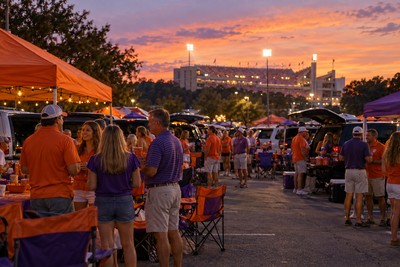
Clemson football game days can involve hours of tailgating before kickoff, followed by heavy traffic after the game. People may spend much of the day eating, socializing, walking, standing, and drinking before leaving the area.
Drinking alcohol at a tailgate does not automatically mean that you committed DUI. The legal issue is whether you drove while your faculties to operate a motor vehicle were materially and appreciably impaired by alcohol, drugs, or a combination of substances.
A game-day traffic stop may begin for reasons unrelated to alcohol. An officer may stop a driver after observing conduct such as:
Speeding
Failing to maintain a lane
Running or rolling through a stop sign
Making an improper turn
Driving in a way that interferes with traffic
Ignoring a traffic-control direction
Having an equipment problem
Being involved in a collision
After a lawful stop, an officer may look for signs that the officer believes are consistent with impairment.
Those observations may include:
Odor of alcohol
Red or watery eyes
Slurred speech
Delayed responses
Difficulty following instructions
Coordination problems
Statements about drinking or drug use
No single observation automatically establishes guilt. A DUI case is evaluated based on the evidence as a whole.
Game-day conditions can affect what an officer observes, but they do not create a separate DUI standard.




What Happens After an Officer Suspects DUI?
If an officer suspects impairment, the investigation may become more detailed.
The officer may ask where you were coming from, whether you consumed alcohol, what you consumed, and when you last drank. The officer may also ask you to perform field sobriety tests.
South Carolina DUI cases can involve several types of evidence, including:
Driving behavior
Statements made during the stop
Field sobriety test performance
Body-camera or dash-camera footage
Breath-test results
Blood or urine test results
Officer observations
Witness information
Other physical or digital evidence
The conditions surrounding the investigation can matter. A Clemson football game may create roadside circumstances that differ from an ordinary traffic stop.
Those conditions can include:
Heavy vehicle traffic
Large groups of pedestrians
Flashing emergency lights
Noise from surrounding traffic
Uneven parking lots or road shoulders
Limited room for roadside testing
Long periods of walking or standing before the stop
A DUI defense review may consider whether those conditions affected what the officer observed or how a field sobriety test was performed.
"He has an innate ability to convey to clients what really matters in their cases."
"John Bateman is my absolute go to peer in the legal field when it comes to questions about DUI. . . . He has an innate ability to convey to clients what really matters in their cases. As a fellow attorney, I highly recommend John to anyone in the SC or NC areas who are looking for... legal representation when facing a DUI charge."
M. Brock

"An excellent DUI attorney. He has received the same field sobriety test training as all police officers in the State"
"John is an excellent DUI attorney. He has received the same field sobriety test training as all police officers in the State, and also the same training as the people who are the instructors of the police officer training courses on field sobriety tests. He is very passionate about DUI's and I recommend him often to people who are facing serious charges in the upstate area."
P. Hammond
"He cares for each of his clients and works extremely hard to achieve results."
"Very knowledgeable and thorough in his preparation and representation of his clients. He cares for each of his clients and works extremely hard to achieve results. I highly recommend this lawyer."
C. Grubbs
Field Sobriety Tests After a Clemson Game
Field sobriety testing can become a disputed part of a DUI case because performance may be affected by more than alcohol.
A defense review may examine:
Whether the testing surface was reasonably level
Whether lighting was adequate
Whether nearby traffic or pedestrians created distractions
Whether the person had an injury or physical limitation
Whether footwear affected performance
Whether the officer explained the test correctly
Whether the officer demonstrated the test
Whether the officer followed the applicable testing procedure
Whether video evidence matches the written report
Game-day fatigue may also be relevant. A person who has spent hours walking, standing, sitting in a stadium, and moving through crowded parking areas may appear tired. Fatigue does not automatically defeat a DUI charge, but it may be one factor when the evidence is reviewed.
Does a 0.08 Breath Test Automatically Mean a DUI Conviction?
No. A breath-test result of 0.08 percent or higher does not automatically produce a DUI conviction.
South Carolina law distinguishes between DUI and driving with an unlawful alcohol concentration, commonly called DUAC.
DUI generally focuses on whether alcohol, drugs, or a combination of substances materially and appreciably impaired your faculties to drive.
DUAC is a separate offense that applies when a person drives with an alcohol concentration of 0.08 percent or more.
A reported alcohol concentration of 0.08 percent or higher may also support an inference that a person was under the influence of alcohol. Even so, the test result and the procedures surrounding the test can still be challenged in a criminal case.
A DUI or DUAC defense review may examine:
Whether the arrest or detention was lawful
When the test occurred in relation to the arrest
Whether required implied-consent information was provided
Whether the person administering the test was qualified
Whether required testing procedures were followed
Whether the breath-testing machine was working properly
Whether video evidence supports or contradicts the officer’s description
Whether the reported result is consistent with the rest of the evidence
South Carolina law permits a person charged with DUI or DUAC to challenge several of these issues.
Related Videos
Refusing Field Sobriety Tests
Choosing a DUI Attorney
What Happens If You Refuse a Breath Test?
South Carolina has an implied-consent law.
If you are arrested for an offense arising from driving under the influence, the law treats you as having consented to qualifying chemical testing for alcohol or drugs. You may still refuse testing, but refusal can create driver’s-license consequences that are separate from the criminal DUI case.
For a person with no qualifying prior DUI convictions or implied-consent suspensions during the preceding 10 years, refusal can result in a six-month driver’s-license suspension.
South Carolina law also provides a 30-day period to request a contested case hearing after a notice of suspension is issued. Depending on the circumstances, a person may also have options involving a temporary alcohol license or the Ignition Interlock Device Program.
This means you may be dealing with two separate matters:
The criminal DUI or DUAC case
The administrative driver’s-license suspension
The deadline for the license issue may arrive well before the criminal case is resolved.
For more information about implied consent in South Carolina, visit:
https://duigreenville.com/implied-consent-greenville-sc/
Can Police Stop Drivers Simply for Leaving a Clemson Tailgate?
Not solely because a driver attended a tailgate.
An ordinary traffic stop must have a lawful basis. DUI checkpoints and roadblocks operate under a different legal framework.
After a Clemson football game, officers may be stationed around intersections, parking areas, major roads, and routes leading away from campus. They may be directing traffic, responding to collisions, observing traffic violations, or conducting DUI enforcement.
If a DUI case begins with a traffic stop, the reason for that stop can be a key issue.
A defense attorney may compare the officer’s stated reason with evidence such as:
Dash-camera footage
Body-camera footage
Dispatch records
Traffic conditions
Witness statements
The officer’s written report
If the stop was unlawful, that issue may affect whether evidence obtained afterward can be used.
For more information about DUI checkpoints in South Carolina, visit:
https://duigreenville.com/dui-checkpoint-laws-south-carolina/
What Evidence Matters After a Game-Day DUI Arrest?
Video evidence can be especially significant in a DUI case.
An officer’s report may describe a driver as unsteady, confused, or visibly impaired. Video may support that description, contradict it, or provide additional context that is not obvious from the written report.
Evidence that may matter after a Clemson DUI arrest includes:
Body-camera footage
Dash-camera footage
Field sobriety test recordings
Breath-test records
Blood or urine test records
Incident reports
Dispatch communications
Witness information
Medical records
Parking records
Receipts
Photographs
Phone timestamps
Text messages
Rideshare records
These materials can help reconstruct what happened before, during, and after the stop.
A DUI attorney can also review whether law enforcement followed South Carolina procedures governing the arrest, testing, video recording, and chemical-test process.
What Should You Do After a Clemson Tailgate DUI Arrest?
Preserving information early can help your attorney evaluate the case.
Write down what you remember, including:
Where you parked
Where the tailgate took place
When you arrived
When you left
What you ate
What you drank
When you had your last drink
Who was with you
Where police stopped you
Why the officer said you were stopped
What the officer asked
What you said
What field sobriety tests you were asked to perform
Whether you took or refused a chemical test
Whether you noticed body cameras or dash cameras
Keep every document law enforcement gave you.
Preserve receipts, photographs, text messages, parking information, tickets, rideshare records, and other records connected to the day.
Avoid posting details about the arrest on social media. Public statements can become part of the evidence reviewed in a criminal case.
You should also pay attention to any driver’s-license suspension paperwork. A 30-day deadline may apply to a contested case hearing after an implied-consent suspension.
For a broader explanation of the process after a South Carolina DUI arrest, visit:
https://duigreenville.com/after-dui-arrest-in-greenville-sc/
A First DUI Can Carry Serious Consequences
A first DUI is still a criminal charge.
South Carolina law provides criminal penalties for a first DUI conviction, and the consequences can increase based on the reported alcohol concentration. A conviction can also involve the Alcohol and Drug Safety Action Program and driver’s-license or ignition-interlock requirements.
The exact consequences depend on the charge, alcohol concentration, driving record, prior offenses, and facts of the case.
A DUI conviction may also affect other areas of your life, including:
Driving privileges
Insurance
Employment
Professional licensing
Criminal record
Personal finances
For more information about first-offense DUI cases in South Carolina, visit:
https://duigreenville.com/first-offense-dui-south-carolina/
Every DUI Case Depends on Its Own Evidence
Two people arrested after the same Clemson football game can have very different cases.
One driver may have been stopped for speeding. Another may have encountered a checkpoint.
One person may have completed field sobriety testing. Another may not have completed the same tests.
One arrest may include clear video from beginning to end. Another may involve incomplete footage, poor camera angles, or disputed observations.
One person may have submitted to a breath test. Another may have refused testing and received an administrative suspension.
A DUI defense should focus on the specific evidence in the case.
An attorney may review:
The reason for the traffic stop
The officer’s observations
Statements made during the stop
Field sobriety testing
Chemical testing
Breath-test procedures
Video evidence
Witness evidence
Administrative license issues
Compliance with South Carolina DUI procedures
Frequently Asked Questions About Clemson Tailgate DUI Arrests
Can you get a DUI if you were drinking at a Clemson tailgate but felt sober?
Yes. Feeling sober does not prevent an officer from making a DUI arrest if the officer believes there is sufficient evidence of impairment. The legal question is whether the State can prove the charge under South Carolina law.
Can police arrest you for DUI if your breath result is below 0.08?
A DUI charge is not limited to cases involving a breath result of 0.08 percent or higher. South Carolina DUI law focuses on whether your faculties to drive were materially and appreciably impaired by alcohol, drugs, or a combination of substances. Chemical-test results are only one part of the evidence.
Is 0.08 automatically a DUI conviction in South Carolina?
No. A result of 0.08 percent or higher can be important evidence and can support a DUAC charge, but guilt is not automatic. Testing procedures, machine operation, the legality of the stop or arrest, and other evidence may still be reviewed and challenged.
Can refusing a breath test affect your driver’s license?
Yes. Refusing a qualifying chemical test after a DUI arrest can trigger an administrative driver’s-license suspension. A 30-day deadline applies to requesting a contested case hearing after the notice of suspension is issued.
Does heavy Clemson game-day traffic matter in a DUI case?
It can. Traffic, pedestrians, noise, lighting, road conditions, fatigue, and limited testing space may provide context for driving observations and roadside testing. Their importance depends on the facts of the individual case.
Talk With a Clemson DUI Lawyer About What Happened
A DUI arrest after a Clemson football game can involve criminal charges, driver’s-license issues, chemical-test evidence, video evidence, and strict procedural requirements.
The Bateman Law Firm handles DUI defense matters in Clemson, Greenville, Spartanburg, and nearby areas throughout Upstate South Carolina.
Attorney John C. Bateman is a former Army JAG prosecutor and former Special Assistant United States Attorney. He is also an NHTSA-certified instructor in the DUI enforcement curriculum and serves on the Board of Directors of the DUI Defense Lawyers Association.
If you were arrested after a Clemson football tailgate, the firm can review how the stop began, what the officer observed, what testing occurred, what video exists, and whether law enforcement followed South Carolina DUI procedures.
Call (864) 406-3776.
Contact The Bateman Law Firm:
https://duigreenville.com/contact/
This article is for informational purposes only and is not legal advice. Reading this article does not create an attorney-client relationship. Consult an attorney about your specific situation.