
Soon after a DUI arrest in Greenville, South Carolina, evidence can begin to disappear, be overwritten, or become harder to obtain. A DUI lawyer may work to preserve police video, breath-test-site video, body-camera footage, dispatch records, 911 audio, photographs, witness information, testing records, and records held by nearby businesses or other third parties.
South Carolina law also sets specific requirements for DUI video recording and chemical testing. Reviewing those materials early can help your attorney compare the available evidence with the officer’s written report and determine what the complete record supports.
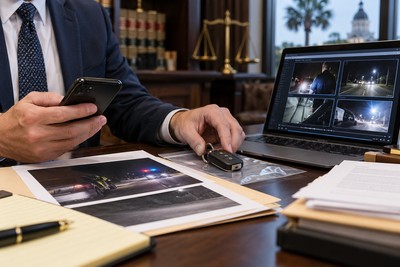
If you have already received photographs, receipts, videos, phone records, medical records, or other information connected with the arrest, keep the original material intact. Do not edit, delete, rename, recreate, or alter potentially relevant evidence.

350+ Reviews
5.0 Star Average






Why Early DUI Evidence Preservation Matters
A DUI case can involve many separate pieces of evidence. The reason for the traffic stop, roadside observations, field sobriety exercises, statements, video, breath or blood testing, and the timing between those events may all matter.
Some evidence may be retained automatically as part of a law-enforcement record. Other evidence may exist only for a limited time. A business security system may overwrite footage. A witness may become harder to locate. Receipts, rideshare records, parking records, or phone information may also become more difficult to retrieve.
Early preservation does not mean that every item will help your defense. The goal is to keep potentially relevant material available so your lawyer can review it before it is lost.
For more information about what can happen after an arrest, visit:
https://duigreenville.com/after-dui-arrest-in-greenville-sc/
Police Video From the Traffic Stop
South Carolina law contains specific video-recording requirements for many DUI arrests. Depending on the circumstances, footage may show the reason for the stop, your movements, conversations with the officer, field sobriety exercises, the arrest, and other events at the scene.
A DUI lawyer may request or review:
- Dash-camera footage
- Body-camera footage, if used by the agency
- Recordings from other officers who arrived at the scene
- Photographs taken during the stop or after a collision
- Audio recorded with the video
- Timestamps and other timing information
Video can be compared with the police report. If the report states that you crossed a lane line, stumbled, misunderstood instructions, or had difficulty performing a roadside exercise, the recording may help show how closely that description matches what happened.
Missing or incomplete video does not automatically mean that a DUI charge will be dismissed. South Carolina law recognizes circumstances that can affect recording requirements, and the legal effect of missing footage depends on the facts of the case.
More information about South Carolina DUI video issues is available here:
https://duigreenville.com/dui-videotaping-laws-south-carolina/




Breath-Test-Site Video and Testing Records
A DUI lawyer may also review video from the breath-test site. That recording may document your conduct, the operator’s actions, and the sequence of events before a breath sample is provided or refused.
The breath-test result is only one part of the evidence. Records connected with the machine and testing process may also matter.
A lawyer may review:
- The breath-test printout
- The testing timeline
- Operator information
- Device maintenance records
- Repair or malfunction records
- Records concerning the machine’s operation
- Breath-test-site video
The goal is not to assume that a breath test is unreliable. The goal is to determine whether the documentation, video, machine records, and reported result are consistent with one another.
You can read more about discovery in a DUI case here:
https://duigreenville.com/importance-discovery-in-a-dui-case/
"He has an innate ability to convey to clients what really matters in their cases."
"John Bateman is my absolute go to peer in the legal field when it comes to questions about DUI. . . . He has an innate ability to convey to clients what really matters in their cases. As a fellow attorney, I highly recommend John to anyone in the SC or NC areas who are looking for... legal representation when facing a DUI charge."
M. Brock

"An excellent DUI attorney. He has received the same field sobriety test training as all police officers in the State"
"John is an excellent DUI attorney. He has received the same field sobriety test training as all police officers in the State, and also the same training as the people who are the instructors of the police officer training courses on field sobriety tests. He is very passionate about DUI's and I recommend him often to people who are facing serious charges in the upstate area."
P. Hammond
"He cares for each of his clients and works extremely hard to achieve results."
"Very knowledgeable and thorough in his preparation and representation of his clients. He cares for each of his clients and works extremely hard to achieve results. I highly recommend this lawyer."
C. Grubbs
Blood or Urine Evidence
When blood or urine testing is involved, the records differ from those in a standard breath-test case.
A DUI lawyer may request:
- Laboratory reports
- Chain-of-custody documents
- Collection records
- Packaging records
- Toxicology results
- Records identifying who collected, transported, stored, or tested the sample
These records may help answer practical questions about the sample. Your lawyer may review when it was collected, who handled it, how it was stored, what testing method was used, and whether the documentation accounts for the sample from collection through analysis.
South Carolina’s implied-consent law also contains procedural requirements governing chemical testing. The significance of a particular requirement depends on the facts of your arrest and the type of test involved.
Independent Test Information
South Carolina law provides a person tested under the implied-consent process with a right, under qualifying circumstances, to obtain additional independent testing by a qualified person of the individual’s choosing and at the individual’s expense.
If you requested, attempted, or completed independent testing, related records may matter. Those records may include:
- Medical-facility documentation
- Transportation information
- Sample-collection records
- Independent test results
- Video or written records showing whether an additional test was requested
If there is a dispute about whether you requested an additional test or whether assistance was provided, the available video and written records may become significant.
More information is available here:
https://duigreenville.com/independent-testing-dui-case/
Related Videos
Refusing Field Sobriety Tests
Choosing a DUI Attorney
Dispatch, 911, and Radio Communications
The written incident report may not show every detail about how a DUI investigation began.
Dispatch logs, computer-aided dispatch records, radio traffic, and 911 recordings may show what information law enforcement received before an officer stopped or approached a vehicle.
These records can be especially relevant when an investigation begins with:
- A citizen driving complaint
- A reported collision
- A welfare check
- A call from another officer
- A report describing a particular vehicle
The records may help establish what a caller said, when the information was received, what was relayed to the responding officer, and what the officer personally observed.
That distinction may matter when your lawyer evaluates the legal basis for the stop and the accuracy of the timeline.
Third-Party Video and Location Evidence
Not all useful evidence comes from law enforcement.
A stop or collision may occur near a convenience store, restaurant, parking lot, apartment entrance, hotel, campus area, or other location with security cameras. Private video may show your vehicle before the stop, activity in a parking lot, a collision, or part of the roadside encounter.
Private systems may overwrite recordings after a limited period. An attorney may consider sending a preservation request asking the owner not to delete or overwrite footage from a specific date and time.
Other third-party records may include:
- Parking receipts
- Business receipts
- Rideshare records
- Hotel records
- Toll records
- Electronic payment records
- Other time-stamped records
These records may help establish where you were and when. Their value depends on how they fit with the rest of the evidence.
Preserving evidence early gives your lawyer more material to evaluate before records disappear or memories become less precise.
Witness Information
Passengers, bystanders, employees, emergency responders, or other people who saw you before or during the stop may have relevant information.
A DUI lawyer may identify possible witnesses and preserve their contact information while the event is still recent.
A witness may confirm part of the police account, contradict it, or provide context that does not appear in the report. The purpose of identifying witnesses early is to preserve access to people who may have relevant information.
Your Own Records
You may also have information that should be preserved.
Examples include:
- Photographs
- Receipts
- Text messages
- Phone location history
- Medical records
- Vehicle data
- Existing videos
- Other records connected with the hours before or after the arrest
Keep existing information in its original form. Do not edit files, change timestamps, delete messages, or create new records to fill perceived gaps.
Your attorney can review the material and determine whether it is relevant and whether it may need to be produced later.
Medical Evidence Can Sometimes Matter
Physical appearance and performance during a DUI investigation can be affected by factors other than alcohol.
A documented injury, physical limitation, neurological condition, balance problem, vision issue, or other medical circumstance may provide context for how you performed a field sobriety exercise or appeared on video.
A medical condition does not automatically defeat a DUI charge. Your lawyer may review medical records when they provide legitimate context for an officer’s observations.
More information about medical issues in DUI cases is available here:
https://duigreenville.com/medical-conditions-dui-lawyer-greenville/
What a DUI Lawyer Is Looking For
Reviewing evidence is not simply about finding one contradiction. A lawyer may compare several sources to determine whether the complete record is consistent.
A lawyer may compare:
- The stated reason for the traffic stop with the video
- The police report with the officer’s recorded statements
- Field sobriety instructions with what you were actually asked to do
- Your movements with the officer’s written description
- The arrest time with chemical-testing times
- Breath-test records with breath-test-site video
- Dispatch information with the officer’s claimed observations
- Witness accounts with the official timeline
Your lawyer may also examine whether required procedures were followed and whether a particular item of evidence is admissible, reliable, or subject to challenge.
The central question is not simply whether police collected evidence. The question is what the evidence shows when the full record is reviewed together.
Why the Police Report Is Only One Part of the Case
A police report matters, but it is still a written summary prepared after the events occurred.
Video, timestamps, audio, laboratory records, machine records, dispatch communications, and third-party evidence may provide independent ways to evaluate statements in that report.
For example, a report may describe you as unable to follow instructions during a roadside test. Video may confirm that description. It may also show that the instructions were interrupted, difficult to hear, or different from the written account.
Neither possibility should be assumed before the evidence is reviewed.
That is why obtaining the underlying evidence can matter as much as reading the report itself.
Evidence Preservation and License Issues Are Separate
Evidence preservation is only one part of what may require attention after a South Carolina DUI arrest.
A DUI arrest can also trigger a separate administrative driver’s license process, especially when a person refuses a chemical test or receives a qualifying test result. Administrative deadlines may differ from the criminal court schedule.
Do not assume that the date of your criminal court appearance controls every deadline connected with the arrest.
The specific consequences depend on the circumstances, including the test result, whether testing was refused, prior history, and the paperwork issued after arrest.
What Should You Do With Evidence You Already Have?
If you have records, photographs, receipts, videos, phone data, or other information related to the arrest, preserve the original material.
Do not:
- Edit files
- Change timestamps
- Delete messages
- Alter photographs
- Recreate records
- Fill perceived gaps with newly created material
Provide potentially relevant material to your attorney so it can be evaluated in context. An item that seems minor at first may become useful when compared with the police timeline, dispatch records, or video.
Talk With a DUI Lawyer About Preserving Evidence After an Arrest
If you were arrested for DUI in Greenville, Clemson, Spartanburg, or a nearby South Carolina community, early review may help identify which records should be preserved or requested.
The Bateman Law Firm can review police video, chemical-testing evidence, dispatch records, witness information, and other available records based on the facts of your case.
Call (864) 406-3776 to discuss your DUI arrest and the evidence that may need to be preserved.
This article is for informational purposes only and is not legal advice. Consult an attorney about your specific situation.