
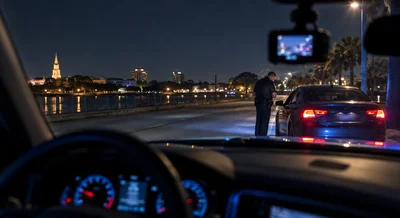
A DUI arrest video can preserve details that a police report may summarize or omit, including the timing of the stop, driving behavior, speech, movement, officer instructions, field sobriety testing, roadside conditions, and parts of the breath-test process. In South Carolina, video has a specific legal role because Section 56-5-2953 requires recording of defined portions of many DUI, DUAC, and felony DUI investigations at the incident site and breath-test site.
A police report may describe a driver as unsteady, slow to respond, or unable to follow directions. Video can show the conduct behind those descriptions. It can also show how instructions were given, what the testing area looked like, how long events took, and whether required portions of the investigation were recorded.
If you were arrested for DUI in Greenville, South Carolina, a useful evidence review compares the police report, incident-site video, breath-test-site video, test records, and other available materials. The Bateman Law Firm can review those sources together and explain where they agree, where they differ, and what those differences may mean in your case.

350+ Reviews
5.0 Star Average





A Police Report Is a Written Account of the Stop
A police report can be valuable evidence, but it is a written account of the officer's observations and conclusions. It may reduce several minutes of interaction to a few sentences. Terms such as "slurred speech," "bloodshot eyes," "swaying," or "failed field sobriety tests" can summarize conduct without showing the full sequence.
Video creates a separate record. It may show what happened before, during, and after the observations described in the report. A side-by-side comparison can help determine whether the written description accurately reflects what the recording shows.
Key point: The strongest evidence review compares the report with the recording instead of treating either source as complete by itself.
For more information about how evidence can be obtained and reviewed in a DUI case, see:
https://duigreenville.com/importance-discovery-in-a-dui-case/




South Carolina Law Gives DUI Video a Specific Role
South Carolina Code Section 56-5-2953 requires video recording of a person's conduct at the incident site and breath-test site for charges under Sections 56-5-2930, 56-5-2933, and 56-5-2945.
At the incident site, the recording must:
- Begin no later than activation of the officer's blue lights.
- Include any field sobriety tests that are administered.
- Include the arrest for DUI or DUAC, or the probable cause determination for felony DUI.
- Show the person being advised of Miranda rights as required by the statute.
At the breath-test site, the recording must:
- Include the entire breath-test procedure.
- Include the person being told that the procedure is being recorded and that the person has the right to refuse the test.
- Include the person taking or refusing the breath test.
- Include the actions of the breath-test operator while conducting the test.
- Include the person's conduct during the required 20-minute pretest waiting period, unless the statutory physical-impossibility exception applies.
A recording problem does not automatically end a DUI case. Section 56-5-2953 includes exceptions involving inoperable equipment, emergency medical treatment, exigent circumstances, roadblocks, traffic-accident investigations, citizens' arrests, and other valid reasons that a court may consider under the totality of the circumstances.
South Carolina appellate decisions also reject a blanket rule that every recording defect requires dismissal. In State v. Taylor, the South Carolina Supreme Court held that suppression of tainted evidence, rather than automatic dismissal, is the proper remedy for certain failures involving the statutory Miranda-recording requirement. In State v. Lowery, the Court held that missing portions of field sobriety testing and Miranda warnings on a corrupted video did not require dismissal on the facts before it.
"He has an innate ability to convey to clients what really matters in their cases."
"John Bateman is my absolute go to peer in the legal field when it comes to questions about DUI. . . . He has an innate ability to convey to clients what really matters in their cases. As a fellow attorney, I highly recommend John to anyone in the SC or NC areas who are looking for... legal representation when facing a DUI charge."
M. Brock

"An excellent DUI attorney. He has received the same field sobriety test training as all police officers in the State"
"John is an excellent DUI attorney. He has received the same field sobriety test training as all police officers in the State, and also the same training as the people who are the instructors of the police officer training courses on field sobriety tests. He is very passionate about DUI's and I recommend him often to people who are facing serious charges in the upstate area."
P. Hammond
"He cares for each of his clients and works extremely hard to achieve results."
"Very knowledgeable and thorough in his preparation and representation of his clients. He cares for each of his clients and works extremely hard to achieve results. I highly recommend this lawyer."
C. Grubbs
What the Video May Show About the Driving
When recording begins by the time the officer activates blue lights, the video may capture part of the driving that led to the stop. A report might state that a vehicle crossed a lane line, varied its speed, braked abruptly, or took too long to pull over. The recording may show how often the movement occurred, how long it lasted, and what traffic or roadway conditions were present.
Context can matter. A brief movement within a lane may look different from repeated lane departures. A slow pull-over on a narrow shoulder may look different from delayed compliance on an open road. The recording can help place a short written description into a visible timeline.
What the Video May Show About Speech, Balance, and Responsiveness
Police reports often use short labels to describe behavior. Video lets the viewer hear and see the behavior itself.
A recording may show whether you:
- Answered questions promptly or needed an instruction repeated.
- Spoke clearly or had speech that was difficult to understand.
- Stood still or shifted position while listening.
- Followed instructions in the order they were given.
- Asked for clarification before attempting a task.
- Appeared to understand what the officer was asking.
The footage may support an officer's written observations, provide added context, or show a different sequence. Its value comes from allowing the conduct to be reviewed directly.
Field Sobriety Testing Can Look Different on Video
Field sobriety testing is one of the clearest areas for comparing a written report with video. A report may list observed "clues" or state that a person performed poorly. The recording may show how the officer introduced the test, demonstrated it, and responded to questions.
NHTSA training materials tell officers to consider test conditions and, when possible, use a reasonably dry, hard, level, non-slippery surface for the walk-and-turn and one-leg-stand tests. A video may document the surface, lighting, footwear, traffic, noise, weather, and any physical limitation mentioned during the stop.
A review can focus on:
- Whether the officer gave the full instructions.
- Whether the officer demonstrated the test.
- Whether you appeared to understand the instructions.
- Whether the test was interrupted or restarted.
- Whether the camera captured your feet and body position.
- Whether environmental or physical conditions visible on the recording deserve closer review.
For more information about reviewing field sobriety testing in South Carolina, see:
https://duigreenville.com/challenging-the-results-of-a-field-sobriety-test-in-south-carolina/
Related Videos
Refusing Field Sobriety Tests
Choosing a DUI Attorney
Video Can Show the Officer's Instructions and the Timing
A police report often focuses on what the driver did. Video can also show what the officer did.
The recording may show whether instructions were interrupted, whether an officer demonstrated a position, whether a test was restarted, or whether you asked a question before beginning. Audio can preserve the exact wording of an instruction that the report later summarizes.
Timestamps can help build a timeline of the investigation. Depending on the available recording and records, a lawyer may compare:
- Activation of the blue lights.
- The initial officer-driver interaction.
- The start and end of roadside testing.
- The arrest.
- Miranda warnings.
- Transportation to the breath-test site.
- The beginning of the breath-test procedure.
- The 20-minute pretest waiting period.
- The breath sample or refusal.
Those times can be compared with the report, citation, breath-test records, dispatch information, and other evidence.
The Breath-Test Video May Show More Than the Number
A breath-test result is only one part of the evidence. Section 56-5-2953 requires the breath-test-site recording to capture the procedure, the person taking or refusing the test, the operator's actions, and the required 20-minute pretest waiting period.
The recording may help answer questions that a police report does not address in detail. It may show:
- When the waiting period began.
- Whether you remained visible during the waiting period.
- What the breath-test operator did.
- What instructions and advisements were given.
- Whether you attempted to provide a breath sample.
- Whether the sequence shown on video matches the written testing records.
A DUI lawyer can compare the recording with the breath-test ticket, simulator-check information, operator records, implied-consent advisements, and other testing documents.
For a current discussion of South Carolina breath-test evidence, see:
https://duigreenville.com/south-carolina-dui-breath-test-challenges/
Missing or Incomplete Video Can Raise Its Own Legal Questions
A blank period, missing audio, blocked camera view, delayed activation, corrupted file, or absent recording may create an issue separate from the officer's written narrative.
The first questions are factual:
- What portion of the recording is missing?
- When did the gap occur?
- What did Section 56-5-2953 require at that point?
- Did a statutory exception apply?
- Is another recording available?
- What evidence does the State seek to use from the unrecorded or missing portion?
The legal effect depends on the defect and the facts. State v. Taylor and State v. Lowery show why a missing or defective recording should not be treated as an automatic dismissal rule. A court may instead consider whether evidence should be suppressed or excluded, whether an exception applies, and how the defect affects the evidence offered in that case.
If you were recently arrested in Greenville, this guide covers practical issues that may follow a DUI arrest:
https://duigreenville.com/after-dui-arrest-in-greenville-sc/
Video Has Limits
A camera does not capture every fact. It cannot record odor. Wind, traffic, distance, and overlapping voices can make audio difficult to hear. Camera angle can hide a person's feet during a balance test. Darkness, glare, rain, or vehicle position can limit what the recording shows.
For that reason, video should not simply replace the police report. A fuller review may compare:
- Incident-site video.
- Breath-test-site video.
- Police reports.
- Field sobriety notes.
- Breath or chemical testing records.
- Dispatch and timing records.
- Witness statements.
- Medical or physical information that is relevant to testing.
- Other available evidence from the stop and arrest.
How a DUI Lawyer Uses the Report and Video Together
A useful method is to build a side-by-side timeline. A lawyer can identify a statement in the police report, locate the corresponding moment on video, and ask whether the recording supports, qualifies, or contradicts the written description.
The review may focus on:
- The stated reason for the traffic stop.
- Driving shown before the vehicle stopped.
- Your responses, speech, and physical movements.
- Field sobriety instructions and performance.
- The conditions where testing occurred.
- The point when the officer made the arrest decision.
- Miranda warnings and later statements.
- Breath-test procedures and timing.
- Missing footage, blocked views, or unexplained gaps.
The goal is not to find one dramatic contradiction. Smaller differences can matter when they affect the context, reliability, or weight of a piece of evidence.
The Bateman Law Firm's Greenville DUI defense page explains other evidence and legal issues that may be reviewed after an arrest:
https://duigreenville.com/greenville-dui-defense-attorney/
Talk With a Greenville DUI Lawyer About Your Evidence
If you were arrested for DUI in Greenville, Clemson, Spartanburg, or another nearby Upstate South Carolina community, the police report may not show every detail of the investigation. The Bateman Law Firm can review available recordings, written reports, field sobriety evidence, breath-testing records, and other case materials with you.
The firm has offices in Greenville, Clemson, and Spartanburg and represents people facing DUI-related charges in Upstate South Carolina and nearby areas.
Call 864-406-3776 to request a free consultation.
You can also contact The Bateman Law Firm at:
https://duigreenville.com/contact/
This article is for informational purposes only and is not legal advice. Consult an attorney about your specific situation.