
September does not change South Carolina DUI law, but it can change the conditions in which DUI evidence is created. In Greenville, Clemson, Spartanburg, and nearby Upstate South Carolina communities, late-summer rain, earlier sunsets, school-year traffic, football weekends, and fall events can affect roadside observations, field sobriety testing, police video, and the timeline of a traffic stop.
The legal question is not whether September itself creates a defense. The question is whether a specific condition changes how a specific piece of evidence should be understood. Wet pavement may matter when balance is evaluated. Congestion may matter when a lane movement is described as unusual. Changing light may matter when a recording is reviewed. Timing may matter when weather or traffic conditions change during the investigation.
The Bateman Law Firm can review those conditions alongside the officer’s report, recordings, chemical-testing records, dispatch information, and the legal basis for the stop and arrest.
350+ Reviews

5.0 Star Average





September Changes the Setting, Not the Legal Standard 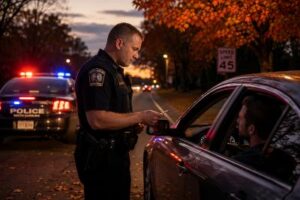
South Carolina DUI law focuses on whether alcohol, drugs, or a combination of substances impaired a person’s faculties to drive to the degree required by law. The statute uses the standard “materially and appreciably impaired.” September does not create a different DUI standard.
What September can change is the setting in which an officer makes observations.
A driver may be stopped on dry pavement early in the evening and asked to perform roadside exercises after rain begins. A stop may start in daylight and continue after sunset. Traffic near a Clemson football game, school event, construction zone, or local festival may affect speed, lane position, braking, and turning.
Those conditions do not prove that a driver was sober. They can provide context for conduct that an officer interpreted as a sign of impairment.
For example, an officer may report that a vehicle moved abruptly between lanes. A recording or other evidence may show that traffic was merging, a lane was ending, vehicles were responding to congestion, or a temporary traffic pattern required the movement.
A DUI evidence review may ask:
- What did the officer report seeing?
• What does the video show?
• What were the road and traffic conditions?
• Did another source of evidence confirm the officer’s description?
• Was there another reasonable explanation for the movement?
Roadside conditions do not erase DUI evidence. They can change how a particular observation should be evaluated.
For more information about how evidence is obtained and reviewed in a DUI case, visit:
https://duigreenville.com/importance-discovery-in-a-dui-case/




Changing Light Can Affect What Police Video Captures
September brings shorter periods of daylight as South Carolina moves toward fall. A traffic stop that begins before sunset may continue into lower light if roadside questioning, field sobriety testing, arrest procedures, or chemical testing take time.
That change can matter because video can become a major part of a South Carolina DUI case.
Headlights, police emergency lights, streetlights, passing vehicles, shadows, camera angles, and reflections from wet pavement can affect what appears on a recording. A video may show details that support an officer’s report, contradict it, or provide context that the written report does not describe.
A roadside recording may help show:
- The condition and slope of the testing surface
• Whether the pavement was wet
• How close passing traffic was to the testing area
• Whether the officer’s instructions were audible
• How the driver stood, walked, turned, and spoke
• Whether the officer demonstrated an exercise
• Whether the recording supports the written description of the stop
South Carolina Code Section 56-5-2953 contains specific video-recording requirements for DUI investigations covered by the statute. At the incident site, the recording generally must begin no later than the activation of the officer’s blue lights, include field sobriety tests that are administered, and include the arrest and required advisement shown by the statute. The statute also contains requirements for recording the breath-test procedure.
The legal effect of a missing or incomplete recording depends on the facts and the statutory requirements. South Carolina law identifies circumstances in which failure to produce a required recording is not, by itself, a ground for dismissal. An attorney can compare the available recordings with the statute, the officer’s explanation, and the rest of the evidence.
"John Bateman is my absolute go to peer in the legal field when it comes to questions about DUI. . . . He has an innate ability to convey to clients what really matters in their cases. As a fellow attorney, I highly recommend John to anyone in the SC or NC areas who are looking for... legal representation when facing a DUI charge." "John is an excellent DUI attorney. He has received the same field sobriety test training as all police officers in the State, and also the same training as the people who are the instructors of the police officer training courses on field sobriety tests. He is very passionate about DUI's and I recommend him often to people who are facing serious charges in the upstate area." "Very knowledgeable and thorough in his preparation and representation of his clients. He cares for each of his clients and works extremely hard to achieve results. I highly recommend this lawyer.""He has an innate ability to convey to clients what really matters in their cases."
M. Brock

"An excellent DUI attorney. He has received the same field sobriety test training as all police officers in the State"
P. Hammond
"He cares for each of his clients and works extremely hard to achieve results."
C. Grubbs
Rain and Roadside Conditions Can Affect Field Sobriety Testing
Field sobriety exercises are often performed where the traffic stop occurs. That may mean a parking lot, shoulder, roadside, or other outdoor surface rather than a controlled indoor setting.
Rain can change the surface beneath a driver. Water can also make painted lines, pavement, gravel, leaves, or other roadside materials more difficult to stand or walk on.
Consider a driver who is stopped in Greenville after a September shower. The officer asks the driver to perform a one-leg stand on a damp shoulder. During the exercise, the driver puts one foot down and raises an arm for balance.
Those actions may become part of the officer’s evaluation. A defense review can still examine the conditions under which the exercise was performed.
Relevant questions may include:
- Was the surface level?
• Was the pavement wet or slippery?
• Was loose gravel present?
• Was the testing area close to moving traffic?
• Could the driver hear the instructions?
• Did the driver have an injury or medical condition that could affect balance?
• Did footwear affect stability?
• Did the police video clearly show the testing surface?
• Did the officer provide the instructions and demonstration shown on the recording?
Rain does not automatically invalidate a field sobriety exercise. The surrounding conditions may affect how the performance should be weighed with the rest of the evidence.
Medical and physical conditions can also affect how a person appears or performs during roadside testing. More information is available here:
https://duigreenville.com/medical-conditions-dui-lawyer-greenville/
Refusing Field Sobriety Tests Choosing a DUI AttorneyRelated Videos
Traffic Patterns Can Change the Meaning of Driving Behavior
Many DUI investigations begin before the officer speaks with the driver.
An officer may describe weaving, delayed braking, unusually slow driving, an abrupt lane change, a wide turn, or another driving pattern. Those observations may be used to explain why the officer initiated the stop and may later become part of the prosecution’s evidence.
September traffic can provide context for some of those movements.
School-year traffic is active. Football weekends in Clemson can bring heavier vehicle and pedestrian activity. Greenville, Spartanburg, Clemson, and surrounding communities can also experience traffic connected with school events, work schedules, sporting events, construction, and community activities.
Suppose an officer reports that a driver changed lanes twice within a short distance. Written by itself, that description may sound unusual.
Other evidence may show that the driver was:
- Approaching a required merge
• Moving around stopped traffic
• Responding to an officer directing vehicles
• Avoiding a blocked lane
• Following temporary traffic controls
• Making room for another vehicle
Those facts do not establish sobriety. They may affect how strongly the lane movement supports an inference of impairment.
The goal of reviewing the evidence is to separate the officer’s observations from the conclusions drawn from those observations.
September Can Make the Timeline More Useful
Timing can matter throughout a DUI investigation.
A defense attorney may compare the time of the officer’s first observation with the activation of blue lights, roadside questioning, field sobriety testing, arrest, transportation, implied-consent procedures, and chemical testing.
Times may appear in several forms of evidence, including:
- Dash-camera or body-camera recordings
• Dispatch records
• Officer reports
• Breath-testing records
• Laboratory documents
• Arrest paperwork
• Witness information
• Photographs or other digital records
Comparing those sources can show whether the timeline is consistent.
Seasonal conditions can make timestamps especially useful. If rain begins during the stop, a timestamp may help establish when the road or testing surface became wet. If a stop begins near sunset, the recording may show how visibility changed while the investigation continued. If unusual traffic control was in place, timing may help identify what was happening on the roadway when the officer first observed the vehicle.
A timeline does not decide a DUI case by itself. It can help an attorney test whether the different pieces of evidence fit together.
The Officer’s Report Is One Part of the Evidence
A police report can be a significant piece of evidence, but it may not provide the complete picture of a DUI investigation.
Depending on the case, other evidence may include:
- Dash-camera recordings
• Body-camera recordings
• Breath-test-site video
• Dispatch records
• Field sobriety notes
• Breath, blood, or urine testing records
• Photographs
• Witness information
• Medical records
• Receipts
• Electronic location information
• Court and arrest paperwork
Comparing those sources can matter.
An officer’s report may describe a driver as unsteady while standing. Video may provide more information about the surface beneath the driver.
A report may describe unusual braking. A recording may show traffic slowing ahead.
A report may describe difficulty during a field sobriety exercise. The recording may show whether the driver was next to passing vehicles, on a sloped shoulder, or dealing with wet pavement.
The reverse can also be true. Video may support the officer’s written observations.
A defense review should not begin with the assumption that every police observation is wrong. It should compare conclusions with evidence that can be independently reviewed.
What Should You Preserve After a September DUI Arrest?
Evidence can disappear over time, and memories can become less precise.
If you were arrested for DUI, preserving information from the stop may help your attorney understand the conditions and timeline.
Useful steps may include:
- Keep your ticket, bond paperwork, suspension notice, testing documents, and court papers.
• Write down the exact location of the stop and the approximate times of major events.
• Record what you remember about the weather, lighting, road surface, traffic, construction, and nearby activity.
• Write down which field sobriety exercises were requested and where they were performed.
• Preserve photographs, receipts, messages, location history, and witness contact information that may help establish a timeline.
• Note any injuries, medical conditions, or footwear that may have affected roadside performance.
• Preserve recordings, photographs, or messages that could relate to the incident.
• Discuss potentially relevant evidence with your attorney before altering, deleting, or discarding it.
An attorney may also evaluate whether police recordings, dispatch records, surveillance footage, or other materials should be requested or preserved.
For more information about what can happen after an arrest, visit:
https://duigreenville.com/after-dui-arrest-in-greenville-sc/
Do Not Confuse the Criminal DUI Case With the License Case
A South Carolina DUI arrest can create a criminal case and a separate driver’s license issue.
Under South Carolina Code Section 56-5-2951, the Department of Motor Vehicles must suspend the driving privilege of a person who refuses a test covered by Section 56-5-2950 or has an alcohol concentration of 0.15 or higher.
If a notice of suspension is issued under that section, the person generally has 30 days from issuance of the notice to request a contested case hearing before the Office of Motor Vehicle Hearings. The statute also addresses options involving the Ignition Interlock Device Program and a temporary alcohol license.
That 30-day period is separate from the schedule of the criminal DUI case.
Waiting for the first criminal court date does not preserve the right to request the administrative hearing if the 30-day period expires first. Review every document received after the arrest and speak with an attorney about the deadlines that apply to your situation.
For more information about South Carolina implied-consent issues, visit:
https://duigreenville.com/implied-consent-greenville-sc/
A September DUI Case Should Be Reviewed Fact by Fact
Seasonal conditions should not become shortcuts.
Saying that it was raining does not resolve a DUI charge. Saying that traffic was heavy does not prove that a driving movement had nothing to do with impairment. Saying that the roadside was dark does not make a recording unusable.
The useful question is whether a particular condition affected a particular piece of evidence.
A case review may ask:
- Did wet pavement affect a balance exercise?
• Did congestion provide context for a lane movement?
• Did lower light, glare, or reflections affect what a camera captured?
• Do the timestamps support the sequence described in the officer’s report?
• Does the available video show the field sobriety testing process?
• Were chemical-testing procedures followed?
• Did the officer have a lawful basis for the stop?
• Does the evidence support the officer’s description of the driver’s behavior?
A DUI arrest is not a DUI conviction. The State must prove the charged offense with admissible evidence. A defense attorney can examine whether the evidence supports the conclusions being drawn from it and whether the required procedures were followed.
For more information about DUI defense in Greenville and nearby Upstate communities, visit:
https://duigreenville.com/greenville-dui-defense-attorney/
Talk With a South Carolina DUI Lawyer About Your Traffic Stop
If you were arrested for DUI in Greenville, Clemson, Spartanburg, or another nearby Upstate South Carolina community, The Bateman Law Firm can review the circumstances surrounding the stop.
That review may include the reason for the stop, driving observations, roadside testing conditions, police video, chemical-testing records, the timeline of the investigation, and any separate driver’s license issues.
Individual facts matter. A condition that is highly relevant in one DUI case may have little effect in another.
Call (864) 406-3004 to discuss your South Carolina DUI charge.
You can also contact the firm here:
https://duigreenville.com/contact/
This article is for informational purposes only and is not legal advice. Laws and procedures can change, and the facts of each case are different. Consult an attorney about your specific situation.