
Yes. South Carolina police may arrest or charge you with DUI even when no officer personally saw your vehicle moving. A conviction requires more. Under South Carolina Code Section 56-5-2930, the State must prove that you drove a motor vehicle within South Carolina while alcohol, drugs, or a combination of substances materially and appreciably impaired your ability to drive.
South Carolina courts have also treated vehicle movement as part of the meaning of “drive.” Simply sitting in a parked vehicle with the engine running does not automatically prove DUI. The State may use circumstantial evidence, witness testimony, video, your statements, and other facts to try to prove that you drove while impaired.
The Bateman Law Firm represents people facing DUI allegations in Greenville, Clemson, Spartanburg, and nearby Upstate South Carolina communities. A no-observation DUI case often turns on movement, identity, timing, impairment, and how well the evidence connects those points.
350+ Reviews

5.0 Star Average





Can You Get a DUI in South Carolina Without Being Seen Driving?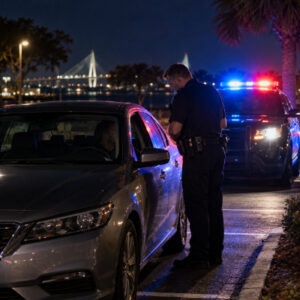
Yes. An officer does not have to personally watch your vehicle move before making a DUI arrest. Police may rely on facts that create probable cause to believe that you recently drove while impaired.
Evidence may include:
- A statement that you drove to the location
- A witness who saw you arrive or saw the vehicle moving
- Security, doorbell, traffic, or parking-lot video
- Evidence of a recent collision
- Fresh vehicle damage or debris
- The location and position of the vehicle
- The engine status, transmission position, lights, or other vehicle conditions
- Receipts, messages, phone location information, or other timeline evidence
The arrest decision and the proof required for conviction are not the same. A prosecutor still must prove every required element of the offense beyond a reasonable doubt.
For more information about South Carolina drunk driving laws, visit:
https://duigreenville.com/drunk-driving-laws-south-carolina/
Why the Difference Between an Arrest and a Conviction Matters
An officer generally makes an arrest based on probable cause. A criminal conviction requires proof beyond a reasonable doubt.
That distinction can be especially significant when no officer saw the vehicle move.
Suppose police respond to a vehicle parked in a Greenville business lot. You are sitting in the driver’s seat, the engine is running, and the officer believes that you have been drinking. Those facts may support further investigation and, depending on the complete circumstances, an arrest. They do not automatically establish when the vehicle moved, who drove it, or whether that driver was impaired when the vehicle moved.
A defense may focus on the missing connection between your condition when police arrived and any earlier driving.




What Does South Carolina Law Require the State to Prove?
South Carolina Code Section 56-5-2930 makes it unlawful to drive a motor vehicle within the state while alcohol, another drug, or a combination of substances materially and appreciably impairs your faculties to drive.
That means a DUI case generally requires proof tying together several facts:
- A motor vehicle was driven
- The driving occurred in South Carolina
- You were the person who drove
- You were impaired to the degree required by the statute while you were driving
When police arrive after the vehicle has already stopped, the timing of each fact can become central to the case.
Being found behind the wheel can be strong evidence in some cases, but it is not automatically the same as proof that you drove while impaired.
What South Carolina Courts Say About Vehicle Movement
South Carolina case law gives the driving element real significance.
In State v. Graves, the South Carolina Supreme Court considered a case in which an officer found a person asleep behind the steering wheel. The engine was running, and the transmission was in gear. The court held that, for purposes of the DUI statute, “drive” requires movement of the vehicle. The requirement can be established through direct or circumstantial evidence.
The facts in Graves did not establish that the defendant had placed the vehicle in motion while intoxicated before the officer arrived. The vehicle moved only after the officer directed the defendant to get out, and the court did not treat that incidental movement as the driving required by the statute.
A later decision, Anderson v. State, shows how a different set of facts can lead to a different result. Officers found Anderson passed out in the driver’s seat at a private residence that was not his home. His foot was on the brake, the engine was running, and the transmission was in drive. He also made statements that the court treated as admissions related to driving.
The South Carolina Court of Appeals concluded that the independent evidence sufficiently corroborated his statements. Taken together, the evidence allowed a reasonable inference that the DUI offense occurred, so the issue was properly submitted to the jury and the conviction was reinstated.
The practical lesson is that an officer does not have to witness the vehicle moving. The State still needs evidence from which a jury can reasonably conclude that you drove while impaired.
"John Bateman is my absolute go to peer in the legal field when it comes to questions about DUI. . . . He has an innate ability to convey to clients what really matters in their cases. As a fellow attorney, I highly recommend John to anyone in the SC or NC areas who are looking for... legal representation when facing a DUI charge." "John is an excellent DUI attorney. He has received the same field sobriety test training as all police officers in the State, and also the same training as the people who are the instructors of the police officer training courses on field sobriety tests. He is very passionate about DUI's and I recommend him often to people who are facing serious charges in the upstate area." "Very knowledgeable and thorough in his preparation and representation of his clients. He cares for each of his clients and works extremely hard to achieve results. I highly recommend this lawyer.""He has an innate ability to convey to clients what really matters in their cases."
M. Brock

"An excellent DUI attorney. He has received the same field sobriety test training as all police officers in the State"
P. Hammond
"He cares for each of his clients and works extremely hard to achieve results."
C. Grubbs
What Evidence Can Be Used to Prove Driving?
When police did not observe your vehicle in motion, prosecutors may rely heavily on circumstantial evidence.
Common examples can include:
- Statements about where you came from or who drove
- Witness testimony about your arrival
- Surveillance or doorbell video
- Traffic-camera or parking-lot footage
- A recent crash or signs that a crash just occurred
- Vehicle damage, debris, tire marks, or fluid
- A vehicle stopped in a roadway or another unusual location
- Engine temperature or whether the engine is running
- The transmission position
- The location of the keys
- Phone location records
- Receipts or transactions that help establish timing
- Text messages or other communications
- Rideshare records
- Evidence about who else had access to the vehicle
No single fact necessarily proves a DUI. A running engine may have an explanation unrelated to recent driving. Possession of keys may show access to the vehicle without establishing that you moved it. A person may also have consumed alcohol after parking.
The strength of the case depends on how the evidence fits together.
Refusing Field Sobriety Tests Choosing a DUI AttorneyRelated Videos
Can You Get a DUI While Sitting in a Parked Car?
You can be investigated and charged after police find you sitting in a parked car. Being parked, by itself, is not the same as proof that you drove while impaired.
South Carolina’s DUI statute focuses on driving. In Graves, the South Carolina Supreme Court distinguished driving from broader concepts such as operating a vehicle or being in actual physical control of it.
That distinction can matter when the evidence shows only that you were sitting, sleeping, waiting for another person, or using the vehicle for heat or air conditioning.
The vehicle’s location may also affect the analysis. A lawfully parked vehicle may present a different factual picture from a vehicle stopped in a travel lane, resting against another object, or sitting in a location that suggests recent movement.
What If You Drank Only After You Parked?
Timing can change the case.
Suppose you drove to a friend’s home in Spartanburg while sober, parked the vehicle, and then consumed alcohol. Police later encounter you in or near the vehicle. Evidence that you were impaired when police arrived does not automatically prove that you were impaired when the vehicle moved.
Evidence that may help establish the timeline can include:
- Receipts
- Text messages
- Surveillance footage
- Witness statements
- Phone location information
- Rideshare records
- Photographs or videos
- The timing of breath, blood, or urine testing
- Statements made to officers or other witnesses
A DUI defense lawyer can compare that timeline with police reports, body-camera footage, dash-camera footage, dispatch records, and other available evidence.
Can Your Own Statements Supply Evidence of Driving?
Your statements can matter a great deal, but the legal analysis does not stop with the statement itself.
Police may ask where you came from, who drove, when you parked, what you drank, and when you had your last drink. You may answer because the encounter initially seems like a welfare check or routine conversation.
A statement such as “I drove here from downtown” can become evidence linking you to earlier vehicle movement.
Anderson also illustrates an evidentiary rule that can matter in these cases. South Carolina courts require sufficient independent evidence to corroborate an out-of-court admission or confession before that statement can support a conviction. In Anderson, the court found that the circumstances surrounding the vehicle and the defendant’s condition sufficiently corroborated his statements.
You should not give false information to an officer. You also do not need to guess about facts that you do not remember. Any recorded statement should be reviewed together with body-camera footage, dash-camera footage, dispatch records, and third-party video.
What Else Must the State Prove Besides Driving?
Proof that a vehicle moved is only part of a DUI case.
Under Section 56-5-2930, the State must also prove impairment to the legal degree required by the statute. Depending on the case, the evidence may include:
- Officer observations
- Driving behavior reported by witnesses
- Field sobriety testing
- Body-camera or dash-camera video
- Breath testing
- Blood or urine testing
- Witness testimony
- Statements about alcohol or drug consumption
- Medical or medication information that may affect observed behavior
South Carolina also has a separate offense called driving with an unlawful alcohol concentration, commonly called DUAC. Section 56-5-2933 applies when a person drives a motor vehicle within South Carolina with an alcohol concentration of 0.08 percent or more. That offense also requires proof of driving.
If the State cannot reliably connect the alleged impairment or alcohol concentration to the time when the vehicle moved, the timing issue may become part of the defense.
How a DUI Defense Lawyer Reviews a No-Observation Case
When no officer saw you driving, a DUI defense attorney may begin by reconstructing the timeline and identifying the evidence that connects you to vehicle movement.
A review may include:
- Police reports
- Dispatch and call records
- Body-camera footage
- Dash-camera footage
- Surveillance video
- Witness statements
- Collision evidence
- Chemical-test records
- Field sobriety testing
- Your recorded statements
- Phone or location records when lawfully available
- Receipts, messages, and other timeline evidence
A lawyer may also review whether police had lawful grounds to detain and arrest you, whether field sobriety exercises were administered properly, and whether chemical testing complied with South Carolina requirements.
Learn more about possible DUI defenses:
https://duigreenville.com/defenses-to-a-dui-charge/
Learn more about practical steps after a DUI arrest in Greenville:
https://duigreenville.com/after-dui-arrest-in-greenville-sc/
What Should You Do After a DUI Arrest When Police Did Not See You Drive?
Preserve evidence before it disappears.
Write down what you remember while the details remain fresh, including:
- Where the vehicle was located
- Who had access to the vehicle
- Who had the keys
- When the vehicle last moved
- Who last drove it
- When you consumed alcohol, medication, or another substance
- Who was present
- What you told officers
- What the officers asked you
- Whether nearby homes or businesses had cameras
Save receipts, rideshare records, text messages, photographs, videos, and location information that may help establish a timeline.
Look for nearby cameras promptly because some systems overwrite footage after a short period. Discuss preservation of potentially relevant evidence with your lawyer.
Do not assume that a DUI charge will disappear because no officer saw you drive. At the same time, being found behind the wheel does not automatically establish every element required for conviction. The case should be evaluated based on the evidence of movement, identity, timing, and impairment.
Talk With a South Carolina DUI Defense Lawyer
If police charged you with DUI even though no officer saw your vehicle move, the evidence deserves a careful review.
The Bateman Law Firm represents people facing DUI allegations in Greenville, Clemson, Spartanburg, and nearby communities throughout Upstate South Carolina. Attorney John C. Bateman is a former Army JAG prosecutor. His DUI-specific training includes NHTSA DUI Detection and Field Sobriety Testing, Advanced Roadside Impaired Driving Enforcement, and the NHTSA DUI Detection and Field Sobriety Testing Instructor’s Course.
Learn more about John C. Bateman:
https://duigreenville.com/john-bateman/
Learn more about the firm’s Greenville DUI defense practice:
https://duigreenville.com/greenville-dui-defense-attorney/
To request a free consultation, call (864) 406-3004.
Clickable phone link:
tel:+18644063004
Contact The Bateman Law Firm online:
https://duigreenville.com/contact/
The firm has offices in Greenville, Clemson, and Spartanburg, South Carolina, and serves nearby communities throughout Upstate South Carolina.
This article is for informational purposes only and is not legal advice. Reading this article or contacting the firm does not create an attorney-client relationship. Consult an attorney about your specific situation.